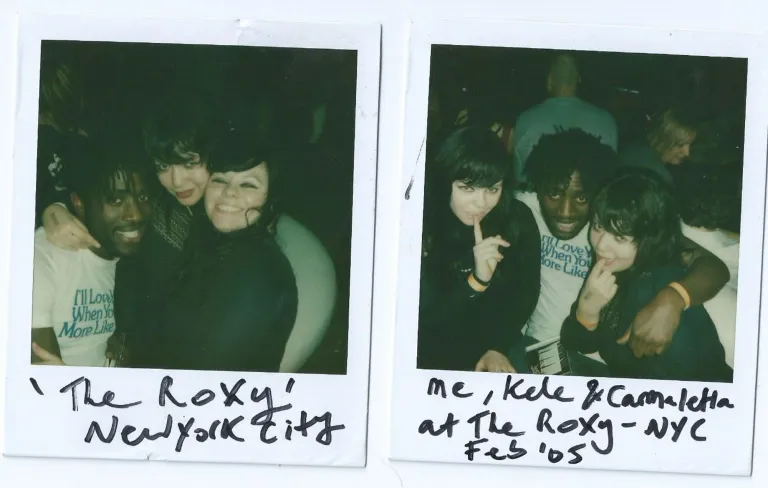
The author of a new book about the ’00s UK scene has spoken to NME about the “hedonism and high ideals” of the time, and if another such wave could ever happen again.
Janine Warren is a former publicist for the likes of Johnny Marr, Bloc Party, Franz Ferdinand, The Libertines, Marianne Faithfull, The Clash‘s Mick Jones, and many more.
Having interviewed artists, friends and familiar faces from across the era along with figures including former NME editor Conor McNicholas and producer Paul Epworth, she has just published the acclaimed The World Was a Mess But His Hair Was Perfect: The Last Indie Music Scene 2000-2010. It relives the “chaotic, creative, and utterly unrepeatable moment” of the birth of a new “British indie movement born at the dawn of social media, thriving on hyper-local scenes, legendary club nights, cheap decadence, and the sheer force of youth culture”.
“If you were there, then it will bring back some memories,” Warren told NME. “If you weren’t, I hope it gives you an insight into what it was like in this pre-digital space and how it felt before you could record everything on your phone.”
The book also comes a foreword from Franz Ferdinand frontman Alex Kapranos and a collection of previously unseen photography by Andy Willsher, the most celebrated gig photographer of the period.
Warren first moved to London at the turn of the century for a role at the iconic Beggars Banquet label.
“I arrived thinking ‘I’ve made it, I’ve got my dream job, I’m working at this really cool indie label with 4AD and XL’,” she recalled. “But then it was quiet and no one was signing anything. I’d go down and see Ed [Horrox, head of A&R] at 4AD and say, ‘What’s happening?’ It would be like, ‘Oh, nothing…’
She then went for a new role as a press officer at Coalition, when suddenly everything changed.
“My interview was seeing The Strokes at their first gig at The Barfly, which was then The Monarch, in February 2001. It was like, ‘Yes, this is exactly what I’ve been looking for: noisy, sexy, rock’n’roll’. That’s what I signed up for.”
Warren continued: “I don’t think you realise at the time, but anyone who was anyone in the music industry was at gig that night. I’ve never seen that venue so full, and it must have all been guest list. Everyone knew that this was it and where we were heading. At the time it was all acoustic-lite stuff like Turin Brakes and Travis coming through. No offence to them, but it was very mild and we just wanted something different.”
When the influence of The Strokes took hold, it wasn’t long before a new wave of UK indie swept away the rotting corpse of the late ’90s and post-Britpop.
Check out the rest of our interview with Warren below, where she explained the seismic shift of the time, when the bubble burst, her thoughts on the term ‘indie sleaze’, and if another movement like that could ever be possible again.

Andy Wilsher/Redferns/Getty Images
NME: Hello Janine. It was The Strokes that first ignited the scene in the UK. Why do you think that British audiences embraced them in the way that they did?
Janine Warren: “The UK loved rock’n’roll music, and that goes back before The Beatles. We like exciting music and we had an empty space that needed filling. I guess that was it. America operates in a different way where their radio stations want big pop and country acts and you have to do a bit more work until you’re accepted. We’re a bit more accepting of acts coming through. NME had a huge impact on the industry and was a signpost for labels, radio and A&R.”
How quickly did things change after that gig at The Barfly?
“It was mainly American bands and some Australians at first. You had The White Stripes, The Von Bondies and that Detroit scene coming through and Yeah Yeah Yeahs from New York, but you also had The Hives and The Vines, The Datsuns, but nothing in the UK.
“UK labels and A&R men didn’t know where they should put their money. The first band really were The Libertines. I remember going to see them in a rehearsal space by Old Street roundabout with James Endeacott [Rough Trade] because he wasn’t sure. I went with Tony [Linkin] who still works with Peter, and we just loved them. I loved the relationship between Pete [Doherty] and Carl [Barât]. They were a double act: very funny, answering each other’s sentences, just excitement about them. They took you down the pub to Filthy McNasty’s (back when it existed) and there was just this whole scene around them that was hidden until NME starting picking up on it.”
What do you remember about The Libertines first making waves?
“The Libertines didn’t cause a stir straight away because their first NME cover was before they’d released any music. So in London, people and the music industry noticed that, but it didn’t really hit out in the regions. It wasn’t a great-selling cover for NME back then because no one knew who they were. They weren’t on the radio or had a song, but it wasn’t until they released a single and started playing with The Vines and The Strokes that they started to make a connection. Then Franz Ferdinand came through after that, and that was it.”

The now classic book and documentary Meet Me In The Bathroom focussed on the New York scene of the time, but your book shows that things were a bit more disparate in the UK at the time, right?
“Yes, scenes are put together by the media to make people excited about something so that they buy the magazine and the music. No one likes being told that they’re part of a scene, they just want to be their own thing, but you need a scene to make something sound like it’s happening.
“Franz Ferdinand have similarities to Bloc Party but they don’t sound alike. They both had inspirations from dance music and wanted to make guitar music that people could dance to, but other than that the way they looked and their influences were very different. But there was definitely an angular, fast, spikey guitar sound.”
And club nights across the UK were really pasting everything together to show that something was happening?
“Yes, and they inspired other club nights to open up in Nottingham, Leeds and other cities where they needed something like. Up to that point, you went to your indie club or your dance club. No one ever thought about bringing all of these genres together with hip-hop or whatever. ‘If it’s a good song that people can dance to then we’ll play it’. That was definitely new. Those clubs brought together people who wanted have before.”
Music and the message was spreading via the internet, but the online world was still in its relative infancy. You could also say that was the last breath of the analogue era…
“You were swinging on this pendulum between the two, which is why it was such an exciting time. In one decade you go from analog to digital, and it’s so quick. At first, you’ve got bands using early message boards, Friendster and things like that. It feels for a time like that space and the internet is going to be this exciting space for young people to create and to connect. It had this freedom to it that disappeared. The corporate people that thought, ‘How the hell are we going to monetise this?’ – they swept in. For a fleeting moment, it felt like a really exciting time where none of the grown-ups knew what to do with it. Young people were using it in a way they’d been using fanzines, but sped up.
“It doesn’t get spoken about enough because there was so much else going on with The Libertines and Pete Doherty’s life, but what he was doing on Libertines.org was really revolutionary and how he was writing to them. He was connecting with fans in a way that had never been done before. There’s something about The Libertines that connects to people who read poetry and watch art films, but they’re also able to connect to that football crowd. The way that Pete was connecting with his audience was very exciting.
“A lot of other bands like The Cribs and Arctic Monkeys were all on Libertines.org and using it to publicise their own bands and gigs.”

Alex Kapranos writes in the foreword to the book that everything was driven by a certain sense of “hedonism and high ideals”. What does that mean to you?
“If you weren’t out, you felt like you were missing out. There was a physicality to it. You had to leave the house and go somewhere to experience it.
“Blaine [Harrison, frontman] from The Mystery Jets talks in the book about how every night there was somewhere to go – whether it was Trash, Frogs, the Queens of Noize night at The Barfly. There was definitely a sense of hedonism. We were in an age post-9/11 when we knew there was a threat of terrorism that could happen at any point (and obviously does happen in London) and I do wonder if we were living with a mindset of, ‘You don’t know what’s going to happen, so you might as well enjoy yourself and do what you want’. I don’t know how conscious we were of that, but you definitely hear it in the lyrics of bands like The Rakes and Bloc Party. There was an anxiety and a tension. They write about what it was like to be getting on the tube in a city that was under threat.
“As for the high ideals, most people had a manifesto: of how they wanted to look, what they wanted to sound like, what people were going to get from them. Franz Ferdinand, The Long Blondes, Bloc Party and a lot of the bands really sat down and thought about what they wanted to put across.
“There were also a lot of really ambitious people. People were partying, but if you look at what people like Paul Epworth accomplished, or how Mairead Nash partied as hard as anyone but went on to manage Florence + The Machine, a lot of people went on to be really successful.”


In doing these interviews, did you uncover a less talked aspect of the era? What were the stories that surprised you the most?
“I loved talking to Ryan and Gary Jarman from The Cribs. I think they’re really articulate and their experience of that decade in how they were gigging was really interesting. They came off a tour set up by the label and were meant to be writing their next album but instead they’d go play Coventry or somewhere random like Wetherby, just because someone had contacted them through a message board or MySpace offering them petrol money and beers. That’s how they made their career. They became so successful but going out to places that people didn’t really play, and I don’t think that’s really possible now because it just costs too much money.
“The fact that they could afford and chose to do that is really interesting. Things have just changed so much. There was a fascinating story in there about them nearly signing to MySpace Records which is just wild.”
The Cribs on MySpace Records? Really?
“Back in the day everyone had MySpace Tom as your friend, and people wondered if he really existed. It turns out he did and he loved The Cribs. He flew them over to America and said, ‘I’m starting MySpace Records, I want you to be my first signing, I’ve got this amazing idea where The Cribs go on these arena tours around America that are also MySpace meet-ups’. Tom said that everyone on MySpace would have to be friends with The Cribs as well as him. It was really surreal. He even offered to change the name of the label for The Cribs but they turned him down because it wasn’t what they were about. Coming out of the meeting, Ross had been so nervous that he threw up in a plat pot outside of Tom’s office, then they never spoke about it every again.
“They’ve got some wild stories. At one point, Ryan was living in Courtney Love’s house. Their vision and memory of that decade is really interesting.”
When do you think the bubble burst on that era of indie?
“I think around 2006. Arctic Monkeys came out and blew everything out of the water. No one was expecting a band from that time to be as big as that. It happens in every scene and decade where a band gets massive and the major labels go, ‘Ooh, we want some of this’. So they start signing bands and a lot of them have only been together for six months and don’t have the songs or experience that bands that had come up before them did. Suddenly you get these bands on major labels with an expectation to sell records and chart and they don’t do it, so they went. That’s when things started to wind down.
“At the end of the decade, Bloc Party were heading into a hiatus after 10 years of touring and getting annoyed with each other, The Rakes fell apart and combusted, Ryan Jarman had a bit of a breakdown, The Futureheads had their mental health problems, the singer of The Long Blondes had a stroke. There was a lot of stuff going on in different bands that brought it to a natural end, but all good things have to come to an end don’t they?”
What do you make of the retro-fitting of the term ‘indie sleaze’?
“I’ve got to say I’m not a fan of that tag. All the bands I spoke to from that time said they didn’t get it or knew where it came from. It’s not how they’d describe it, but it seems to have stuck. I certainly didn’t use it when I pitched the book and didn’t use it in the book.
“It’s difficult, because no one was particularly happy with the tags of the ‘new rock revolution’ or the post-punk scene either. I’m really glad that the people are picking up on the music and the image. Instagram is full of accounts about indie sleaze and photos from that time because there’s a certain type of aesthetic to it. We’re always inspired by what went before and things move in 20 year cycles.”
Could we have another huge indie wave like that again?
“I’d like to think so. It was everything around the scene that built the wave. The bands still exist, but you need the media and world around it. Bands like Geese are coming up right now and others will follow. Instagram and TikTok have their place, but that will pass. There will be other stuff that we haven’t even thought of yet that will change everything. People thoughts books were over, but independent shops are opening up everywhere because people love spending time there.”
The World Was a Mess But His Hair Was Perfect: The Last Indie Music Scene 2000-2010 is out now via Omnibus Press
The post The new book that revisits the messy magic of the UK ’00s indie scene: “If you weren’t out, you felt like you were missing out” appeared first on NME.